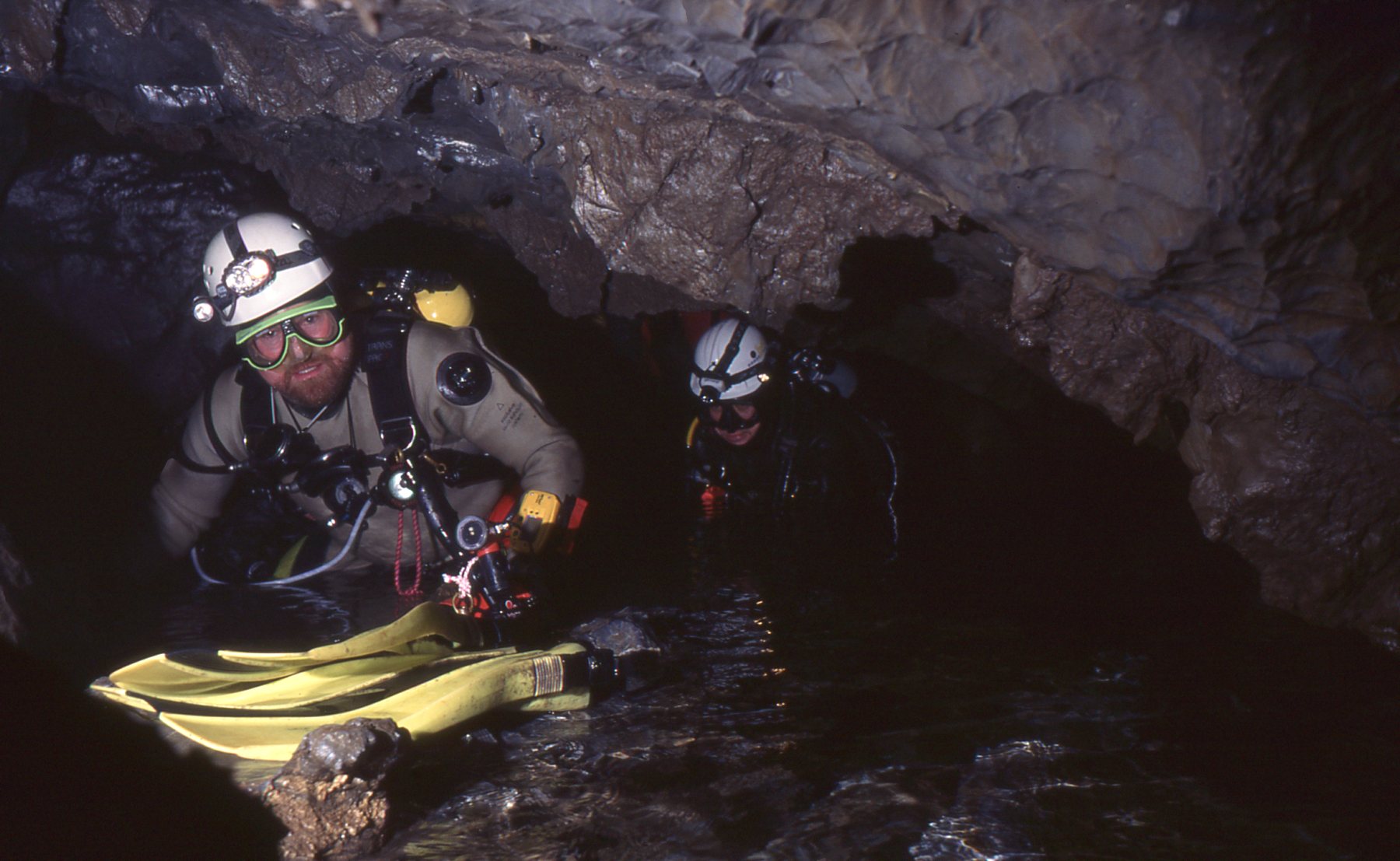
Sometimes the simple things are the best. Edd Sorenson of Cave Adventures, suggested we manufacture a stage strap for sidemounting a stage bottle when sidemounting primary cylinders. While we were diving Jackson Blue, Edd showed me his set up. James Clark came up with the idea. It looked too simple to work, but it did. Back at the office, we made some samples of this bungee stage strap and we’ve been using them on exploration dives ever since.
On the first sidemount, stage dive into a snarly area I used Edd’s system and didn’t even realize I had the extra bottle on even though I was moving through turns and squeezes. I even had Wes Skiles’ son Nate sidemounting four bottles, two on each side through passage divers with backmount can get stuck in.
The sidemount stage rig is designed to work with the Nomad. A couple of points to make the rig work, use it with aluminum 80’s or the new al 77 – don’t try it with steel cylinders. The bottom clip is 15” from the bottom of the cylinder. Both straps are made from 3/8 diameter bungee and just enough stretch so they clip in and stay out of the way behind the primary bottle. It’s not for everyone but if you want to stage with sidemount it’s the slickest thing I’ve seen. BC2720-STAGE is the model number if you’re interested.
Lamar
Sidemount Stage Bottle Set Up
Last year an aluminum stand for the O2ptima was available through a third party in limited supply. It was very expensive on the open market so I didn’t look into it. Things changed when I taught the stand’s designer CCR Cave and we talked about the stand. He has made some changes and we now have the Sisco Aluminum Stand for the O2ptima. It’s all aluminum and the foot is adjustable from aluminum 13s to steel 27s and even the longer aluminum 19s. It’s rugged. I have been field testing it for over a month and talked to the people who bought the first ten he produced. Everyone is very happy with it. We launched a new video last week showing all the new features of the O2ptima and we immediately sold through our initial supply of these stands. You can get them direct through Dive Rite. DRT-49-STAND. $225.00


We are producing a new run of O2ptima jackets at the end of September so now is the time for a customized jacket. Get your name or a design or both. The factory has a few stock designs or if you are an artist – go for it and we can digitize your artwork. All stock designs can be seen in the PDF file in DOWNLOADS next to the O2ptima description. Order these from us at support@diverite.com DRT-54-COVER. $150.00
Lamar
I’ve been away from my blog this past month, busy with diving. First a trip to Russia to do some training, then mini lobster season in the Florida Keys. I just returned from an attempted dive on the Monitor and jumped back into a cave exploration project locally. Now I am scheduling a trip to Australia to teach an O2ptima rebreather course.
As for the Monitor trip, I was 230-feet away from the wreck, standing on the deck of our dive boat in full gear just waiting for the boat to swing around so I could jump. My dive buddies, Pete and Vince, were right behind me. The wind caught the boat and the down line fouled in the screws. The dive was aborted and the next 90 minutes were spent getting it taken care of as the winds picked up to take our only window of opportunity away from us. We didn’t even leave the dock the first two days because it was blowing. We tried to go out again the following day, but it got more rough and windy as we approached the sight. I was concerned the NOAA representative would be upset and not give us another chance but he smiled an informed us that all the past Monitor expeditions only had a 40% success rate in the “Graveyard of the Atlantic”. A famous comedian once said “That was a valuable piece of information to have”… so we are planning again for next year.
This field activity keeps me motivated: watching how people use and misuse our gear. Plus it keeps our team at headquarters happy to have me out of the office:). I’m not sure what other dive companies are doing, but we are moving forward on a number of fronts. Stay tuned to the website for upcoming product releases and new programs. We love the dive business because we are divers, not because it’s a living. This year marks our 25th anniversary. I feel very fortunate to be able to do what I love.
Lamar
We have received several NiTek X computers in for service and all they really needed was a new battery. I asked the programmers how the battery indicator worked to get a better understanding of what’s happening. The chart below gives you an idea of how the indicator works.
The important thing to notice is the discharge curve after 50 hours of normal use. This can be accelerated by using the backlight for long periods. When you notice the battery indicator has moved from full it is really a notice that the battery should be changed within the next 20 hours of dive time. If you don’t, the NiTek X could go dead during a dive.
The battery indicator will be good until the battery goes through roughly 3V – so the battery scale moves between 2.9V to 2.4V as empty. The curve on the batteries are like this:

CR123A Battery Discharge
So anything above 3V is just an artifact of a fresh battery.
If you measure a new battery it is common to see 3.2V even with some load. In sleep the Nitek X uses a very low current so the computer will show a curve like the above, yet flatter. If the computer is in standby a long time the battery will be at a higher voltage than it would after some use, because there was no load during sleep. CR123A also does self-discharge about the same rate as the NiTek X sleep current.
So if the battery gets low and the diver takes it out of sleep it might just drop the voltage quickly and die, or fail to start after a long time. Or if the diver dives with backlight at the end of battery life and then the NiTek X goes to sleep, it may not turn on the next time.
Before sending your NiTek X to us for service, replace the battery. And keep an eye on the indicator.
Lamar
Lately we have received customer support email from people with a common problem. When wearing their new TransPac, the tank is too high and they can feel the tank valve at the back of their head. If you have the right size harness then the problem can be easily addressed if you look at the TransPac as a new piece of gear and not the latest version of an old BC.
Make sure that the side plates are close to the backplate. When you put your arms down by your side the leading edge of the plate should contact your arm, not the center or back of the plate. Some people say they like the plates forward so the adjustment straps are easier to adjust, this is the first mistake. The adjustment straps are to tweak the size from wetsuit to drysuit and are rarely adjusted. If you like to play with them that’s the problem.
Proper fit is
1. Step into the harness
2. Adjust the chest strap so the shoulder straps come straight down over the shoulder.
3. Fasten the waist belt, make sure it is snug
4. Pull slack out of the shoulder/plate adjustments but not too tight
Since the design is similar to backpacking, the lower you sit when putting the harness on and pull slack out of the shoulder straps the higher the tank will ride. Don’t try to pull all the slack out of the adjustment, you could be looking at the regulator over your head. So don’t tighten it too much and use a crotch strap, it helps center the rig and keep it from moving around. If you have problems I am always ready to go diving and help, you just need to come to my backyard.
Watch our TransPac fitting videos to see what I am talking about.
Lamar
We received two NiTek X units in service due to display errors. The DESAT information would not come back once the X was awakened after going into sleep mode. I tested it and found this to be true, but random. I then learned the following from the programmers.
DESAT, or desaturation time is the amount of time that must pass before the residual nitrogen and helium levels drop to a point where subsequent dives are treated as a single (non-repetitive) dive. This is not the same as “time to fly”. On the NiTek X DESAT times are displayed when the PGT bar graph (on the right of the computer screen) is showing one or more bars.
This explanation gives more merit to tracking tissue saturation than a 12 to 48 hour countdown most dive computers do including the earlier NiTek 3 and NiTek HE. When diving the NiTek X I see a noticeable reduction in decompression time compared to the NiTek Plus. A 60 minute dive at 100-feet using 32% Nitrox gives me 15 minutes of decompression on the NiTek Plus and then 8 minutes after switching to oxygen at 10-feet. The NiTek X only gives me 1 minute of decompression on Con 1 setting. The more information a dive computer uses to calculate decompression the better the results. The X uses 16 tissue compartments while the NiTek Plus uses only 9 compartments. You can customize the X for deep diving with variable gradient factors to make the decompression fit the environment.
We’ll look at adding a standard countdown in the next software upgrade.
Lamar
The X is in full production now and we have inventory in-stock. I have over 100 hrs on my unit. We are building the NiTek X in-house at Dive Rite. This gives us full control to improve the product and track changes. One improvement we did before we shipped the first 50 beta units was to change the battery cap. The original cap could be tightened with a coin, but this could scar the cap. We changed it to a cap with finger grips like the Fischer cap on the other side, plus we added a new cap spring.
This fixed one problem, but created a new one. Since the new cap can be installed without a tool people like to check the battery and don’t tighten it securely. If it is not tight pressure can push the cap and you can lose connection and the computer resets. All units leave the factory with the cap secure and pressure checked to 275-feet. If you have the urge to pull the battery for any reason make sure the cap is tight. We have a tool (CO8212) if you feel the need to pull the battery and check it frequently. The battery should last the average diver over a year.
The X has a sleep mode and pushing either button will wake it up. It stays awake for 10 minutes before returning to sleep mode to conserve battery power. It is auto activated at 5-feet (1.5m) via the pressure transducer, not a wet switch.
Lamar
By request we introduced dust caps for the O2ptima rebreather head to seal the cartridge without removing it. Later, we introduced calibration caps so a diver doesn’t need to fill the loop multiple times to calibrate the unit. Now we use the calibration caps for both uses. Take the thread protectors from the harness mounting bolts (5/16”) and slide one over the inflator inlet nipple on the calibration cap to seal the head. I am pulling the Dust Caps off the market because I have received a second report of a damaged head. Both heads were pressurized when the caps were put on for storage, but the diver didn’t shut down the oxygen supply. If the Hammerhead wakes up it will inject O2. Do I need to say more?
Use the calibration caps to seal the head if need be. For those that have a set of dust caps, send them to us in Lake City and we can convert them to calibration caps with the inflator inlet for $25. Email service@diverite.com
Lamar
We have new software called Dive Logbook for the NiTek Trio and NiTek Duo computers. The scrolling marquis on the NiTek Trio can be changed via the software. Dive Logbook is not compatible with NiTek Logic, so any dives recorded in Logic will not incorporate into Logbook. The NiTek Plus will continue to use NiTek Logic software. Dive Logbook is available for download listed under the “Downloads” tab in the NiTek Trio page of our online catalog.
The NiTek Trio uses the Bulhman algorithm like the NiTek Duo and other Dive Rite computers. The deep stop feature is not new gradient factors in the computer, but rather a simple method of incorporating deep stops without adding time to the shallower stops.
When deep stops are turned on it will add deep stops to any dive with more than 5 minutes of decompression. Deep stops are calculated by splitting the difference between max depth and the first scheduled shallow stop. For instance if you make a 100’ dive for 60 minutes and have a 30’ stop the first deep stop will be at 60’ for 1 minute. It will continue to give you 1 minute stops every 10’ until you get to the scheduled 30’ stop. The Trio is not designed to be a technical computer, but an advanced recreational computer. It doesn’t do Trimix so deep stops will not be accurate for helium. The Trio will slow your ascent and let you do deep stops without suffering increased time at shallower stops.
Lamar
LED lighting technology is rapidly changing and we are delivering the best lighting that we can. While others package existing technology from other industries into a dive light, we have actually engineered our LED technology specifically for our own underwater handheld and canister lights.
It was a challenge to the electrical engineers to create the packaging and heat sink for our product. Our LED products can run out of water without excessive heat buildup. The latest generation of canister light the LED LUX is the culmination of this design. We were able to increase the output and the rated burn time. We started testing the new design with the later LED 700 releases seeing them get up to six hours of burn time on a light that was originally rated at four hours. The LED LUX is brighter and will burn up to six hours on a new battery.
In our product manual, we are rating it conservatively at 5 hours after I tested it on my own three-year old batteries. We rated it for the lower time of five hours to be conservative for divers wanting to upgrade from the older MR11 HID light. The light is designed to never leave you in the dark, the rated burn time is based on a constant voltage of 10.5 volts and when it drops below that it tapers like the LED handheld to give up to an hour of lower output light. We use NiMH batteries to take advantage of their discharge capabilities and recovery from deep discharge to take advantage of LED performance.
Look for a new canister with longer burn time coming soon.
Lamar